

Dilli Haat is located at the commercial area of South Delhi and opposite to INA market on the Sri Aurobindo marg. The bazaar is situated at the 6 acres land, which was salvaged to be part of the reclamation project and then it was transformed into a dream project of “Dilli Haat”. The Haatis developed with extensive foundation work with small roof cottages that provides village atmosphere. This look of the Haat as made it an attractive place for the visitors. The Haat means weekly market in semi-urban, rural and urban India.
Dilli Haat Shopping provides a full exotic variety in shopping products that includes handlooms, handicrafts, woodcarvings, camel hide footwear, drapery, fabric made clothing, gems, beads ornaments etc. The handicrafts stall in the bazaar is placed on rotational basis where the shops will have different product every after 15 days, so that the tourist and visitors can enjoy shopping different products emphasizing different part of India and even the craftsmen get a chance to place
their products in the Dilli Haat.
The Dilli Haat is not just a shopping place but it also visualizes the traditional culture, where the rural life and folk arts are combined and brought closer to the urban city. This place gives an opportunity to the craftsmen to demonstrate their talents and skills to the thousand visitors who come and visit the place.
The complex also has 25 stalls related to different cuisines from different parts of state and Union Territories, an exhibition hall, small shopping stalls featuring gift items, and an open stage used to perform cultural events by the artists flowing from different states, there is a separate playing area for children.
ARCHITECTURE OF DILLI HAAT:
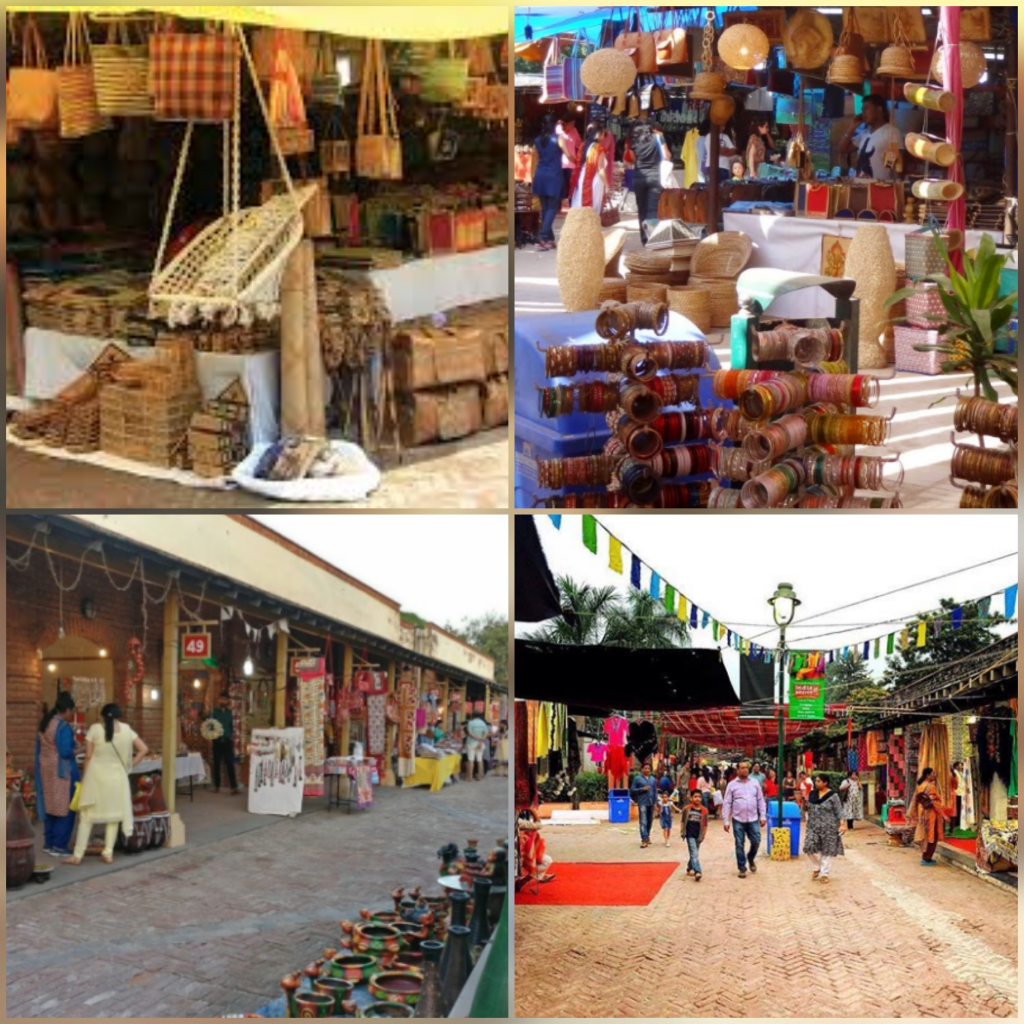
Dilli Haat area is a structure that reminds us of the architecture prevalent in northern parts of India with strong brick walls and roofs made of stone. The cloth materials that are woven on the hand operated looms are all housed in the central hall. Tourists can visit the gift shop to buy souvenirs for loved ones back home.
The other outlets for each state that are just humble cottages or booths create a rustic ambience with their makeshift structures and thatched tops.
Slightly raised, set above the level ground are the stalls that serve as connections in the Dilli Haat. The empty spaces are laid out in stone and there is some greenery all around. All through the place there are blooming plants which adds more color to the beautiful haat.
ENTRANCE PLAZA:
The entrance plaza is a raised congregational platform having pedestrian entrance from both north and south ends. This raised level helps in directing the vehicles around and not through it. The open entrance plaza has ticket counters, ATMs and landscaped areas with seating. This space also serves as a waiting area. The presence of landscape areas makes the plaza even more heart-warming.
CENTRAL PLAZA:
The entrance plaza transforms into an axial spine bringing about the feel of a shopping street. This rectilinear space is flanked by permanent and temporary shops on either side. The zones defined for food, play and arena are situated at the end of the axis. The linearity of the plaza indicates the direction of movement. It also acts as a spill over space for the shops. To break the monotony of the oblong space, few green patches of lawn are inserted which divert the movement of circulation and creates interest among the users.
SHOPPING STALLS:
Since Dilli Haat was set up purely to promote rural and urban handicrafts, the main products for sale are handicrafts antiques, European fashion, rugs, carpets, leather, silk, furniture, jewellery, linen and fabrics, carved stone, precious stone and so on. These shops function on a rotational basis of 15days.
The permanent shops are approximately 2.5 X 3.5 m in area with a 2m shaded corridor. The temporary stalls are of 2 X 2.5m area made of plastic sheets or fabric tied to logs. These shops are either arranged along a linear path or along a curved path.
FOOD ZONE:
The food zones are located on both sides towards the west end of the spine. There are 25 different stalls representing different regions of India. Spill over spaces with informal seating are provided around these food stalls. The food stalls are placed in proximity, thereby having common service areas.
PERFORMANCE ARENA and PLAY AREA:
The linear movement culminates with the Play Area and Performance arena. This is an open space with a stage of 5-6 m diameter with 3 green rooms behind the stage of size 2.5 X 2 m. The placement of this arena towards the end of the space makes it more private and isolated. Being an activity area, it must attract more audience by being well integrated with the other spaces to the Haat.
OFFICES AND STORAGE ROOMS:
The administrative offices and storage rooms are shielded away from the public view and do not lie in the main circulation path.
SERVICE ENTRY:
The service entries are provided on the periphery of the site. Since the food stalls are grouped at proximity, they share common service entries. The presence of service pores at the periphery of site helps in smooth circulation of goods without hindrance to public pedestrian movement within the Haat.
 FREE REIN