
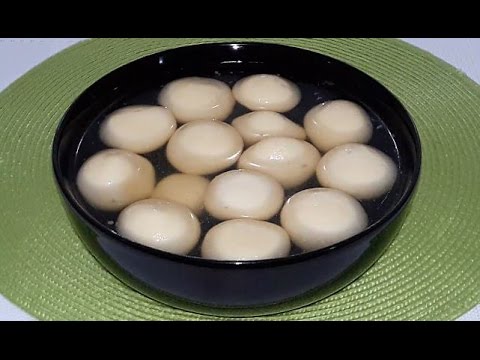
Being a Bengali, and having a sweet tooth, it’s very common and I am no exception… How can we forget, Bengal being the land of sumptuous food and sweets, there are a variety of misthi found there… name one and you can find it…
Not to forget one of the most famous sweets of Bengal, Rosogolla…
Some years back there was a legal battle between Bengal and Odisha regarding the origin of Rosogolla. The legal battle between Bengal and Odisha had finally come to an end, with the coveted Geographical Identification (GI) tag on Rosogolla being awarded to West Bengal on November 14, 2017.“This has been settled under the GI Act that authenticates products to either geographical locations or to communities or societies,” said Sanjay Bhattacharya, deputy controller of patents and designs in Kolkata, declaring the end to a tussle going back two-and-a-half years and a debate raging for decades.
Few days back I watched this movie named “Rosogolla”,made in the year 2018 was an Indian Bengali drama film directed and written by Pavel. It is a fictionalised biopic of Nobin Chandra Das, sweet maker from Kolkata, West Bengal. The film narrates the story of the invention of Rosogolla. Nobin Chandra Das’s father dies soon after Nobin’s birth and his family faces financial crisis. Nobin decides to become a sweet maker. His love interest (later wife) Khirodmoni suggests and inspires him to invent a new type of sweet. After years of hard work and multiple failures, Nobin invents Rosogolla. This invention makes him famous in West Bengal.
This is where I got the inspiration from, to dig into the history of Rosogolla further…..
If there has been one sweet dish that has been a true ‘game changer’ of the way sweets are perceived and eaten in India, it has to be the luscious Rosogolla – or how famous British chef William Harold described it in a journal – “a bowl of sweet, syrupy, soft cheese balls.”
West Bengal, the state synonymous with the quintessential Rosogolla, could hardly have taken this claim lying down. Also, now that we are talking about Bengalis, let’s just call it Rosogolla! Pronounced ‘raw-show-golla‘, the Bengalis claim that it was developed by Calcutta gentleman Nobin Chandra Das in 1868 and popularised by the following generations of his family.
Das tried to boil chena balls in sugar syrup, but they would just disintegrate. After sustained effort, he was able to master the art of holding the balls together, and thus was born Rosogolla. His customers loved it. Despite well-wishers advising him to patent his creation, Das then taught the intricacies of the art to various sweet makers because he believed that his creation would become famous only if it were available across the country.
Das’s invention became a huge success among Bengalis. Legend has it that Pashupati Bhattacharya, a famous medical practitioner of Bagbazar, used to carry Das’s Rosogolla whenever he visited Rabindranath Tagore. Once, the shop had run out of stock when Bhattacharya arrived. As a result, he had to purchase the sweet from a nearby shop. Tagore felt the difference at once and asked the doctor to bring Rosogolla from Das’s shop only.
Here is an interesting anecdote about the deep fondness British colonial rulers in India harboured for the Rosogolla.
William Harold was a famous British cook who was sent to India to help with the war efforts. His dishes were so delicious that a high-ranking officer, who tried one of dishes, ultimately promoted him to be his personal cook. One day, the officer ordered William to fetch the recipe of the Rosogolla, a local dish he ate and fell in love with.
Back then, written recipes were very few and very between, so William had to physically walk from home to home, knocking on every door, in order to get hold of that recipe. However, in spite of his on-field research, he failed to acquire the recipe of the Rosogolla.
Every home he visited gave him a different recipe and a different technique to work with. Unable to replicate the result, Harold left the country with 10 boxes of Rosogolla and the hope that he would eventually be able to recreate the dish. Whether he ever succeeded in doing so remains a mystery.
West Bengal is preparing a detailed dossier on historical evidence compiled in collaboration with K C Das, the sweet chain founded and run by Nobin Chandra Das’s descendants. Their key argument, also pointed out by food historian KT Acharya, is that Bengalis learnt how to make chena from the Portuguese and were the first to experiment with it for their sweets. Elsewhere in India, the separation of the chena from the milk was thought of as sacrilege since milk was offered to the gods.
With so much tradition and history invested in it, Kolkata is unlikely to give up its claim as the iconic sweet’s birthplace.…
 FREE REIN
Love it
LikeLike