
Kolkata also known as City of Joy…. Or we can say synonym of Kolkata would be Fun, Food and Frolic.
Kolkata as we all know is the Capital City of West Bengal State in India. It was former capital of the British empire before the government was shifted to Delhi, Kolkata has a distinct tinge of its royal past lingering in every nook and cranny of the city.
Though Kolkata has its rich past and history but has grown as a Contemporary City of Modern India over the years. It was a real pleasure to visit and reinvent this City of Joy.
The places to visit in Kolkata from an eye of an Architect:
HOWRAH BRIDGE:
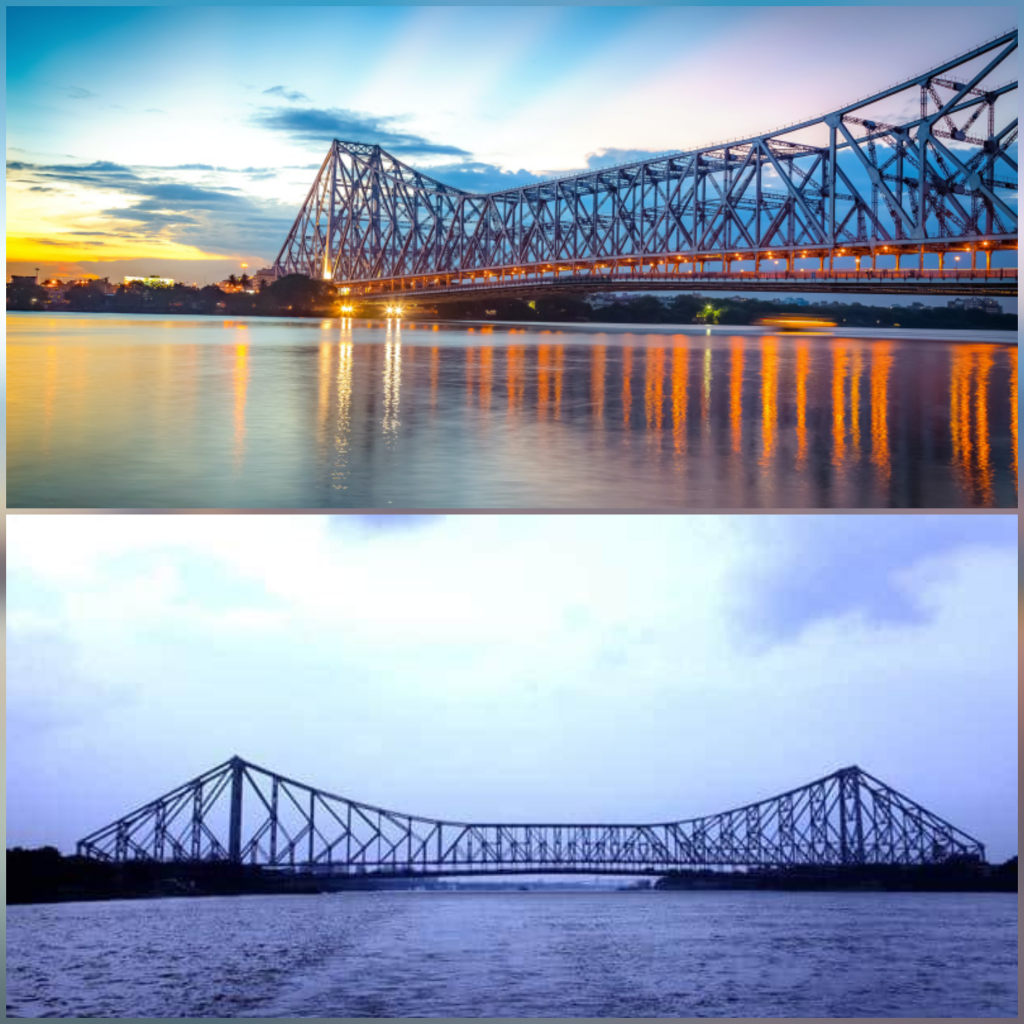
One of the most significant sightseeing spots is the Howrah Bridge that is a cantilever bridge. It is one of a kind and is also the sixth largest bridge in the whole world. The bridge was commissioned in 1943 and was initially called as the New Howrah Bridge since it had replaced the pontoon bridge. It links two major cities- Kolkata and Howrah and is built over the famous River Hooghly.
Howrah Bridge is counted among the busiest cantilever bridge across the globe. It is reckoned as an outstanding engineering work accomplished by the British. Amazingly, the entire structure of the bridge does not include any nuts or bolts. The bridge was made from 26500 tons of high-tensile steel, supported by 2 piers. Each pier of the Bridge is around 90 meters above the road. At the time of its building, Howrah Bridge was acknowledged as the third longest cantilever bridge. Presently, it is the sixth longest bridge of its type in the world.
Howrah Bridge features two sections that covered the whole bridge connecting both the sides. The bridge has also been illuminated by electricity. Howrah Bridge boasts a length of around 1528 feet, and it has a width of about 62 feet. There are wide pavements on either side of the bridge, which are 7 feet wide. The road of 48 feet with 8 lanes serves commuters and traffics all-round the day. The Height of Howrah Bridge from the riverbed is 29 feet. Howrah Bridge bears a regular traffic load of roughly 90,000 vehicles and countless pedestrians.
INDIAN MUSEUM:
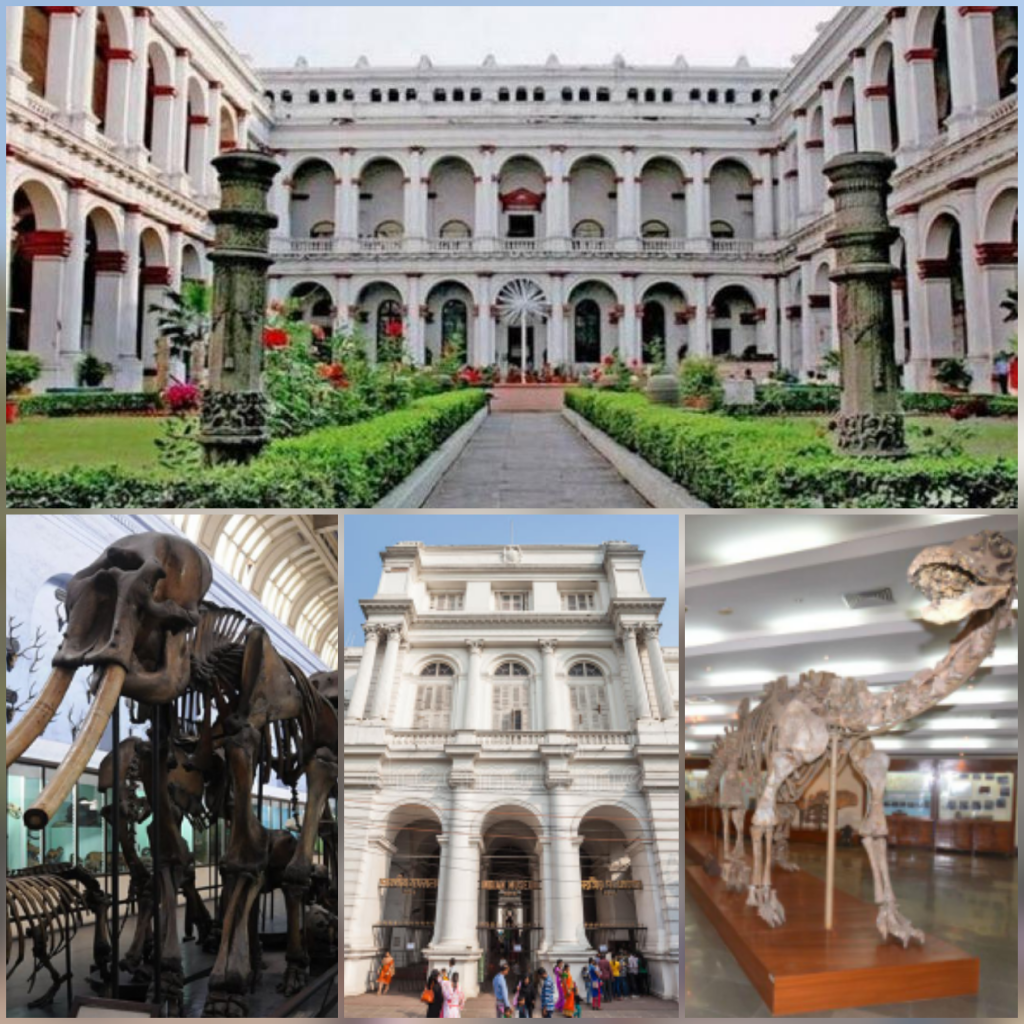
The Indian Museum in Kolkata is situated on 27, Jawaharlal Nehru Rd, Fire Brigade Head Quarter, New Market Area, Dharmatala, Taltala, Kolkata, West Bengal 700016.
It features beautiful, unusual and ancient artefacts, the museum is known to locals as Jadu Ghar, the House of Magic. Founded in 1814, this old-fashioned museum fills a colonnaded palace ranged around a central lawn. The imposing building, designed by Walter Granville, also the architect of the General Post Office, dates to 1878.
The Indian Museum in Kolkata, West Bengal, India, also referred to as the Imperial Museum at Calcutta in colonial era texts, is the ninth oldest museum of the world, oldest museum in India and the second largest museum in India, after the Madras Museum, and has rare collections of antiques, armour and ornaments, fossils, skeletons, mummies and Mughal paintings. It was founded by the Asiatic Society of Bengal in Kolkata (Calcutta), India, in 1814. The founder curator was Nathaniel Wallich, a Danish botanist.
It has six sections comprising thirty five galleries of cultural and scientific artifacts namely Indian art, archaeology, anthropology, geology, zoology and economic botany. Many rare and unique specimens, both Indian and trans-Indian, relating to humanities and natural sciences, are preserved and displayed in the galleries of these sections. In particular the art and archaeology sections hold collections of international importance.
It has six sections comprising thirty five galleries of cultural and scientific artefacts Snamely Indian art, archaeology, anthropology, geology, zoology and economic botany. Many rare and unique specimens, both Indian and trans-Indian, relating to humanities and natural sciences, are preserved and displayed in the galleries of these sections. In particular the art and archaeology sections hold collections of international importance.
Built around a courtyard are two storeys of galleries. The Archaeology Gallery, to the right of the main entrance, has railings from the Bharhut Stupa as well as displays of ancient and medieval sculpture. The Numismatics Gallery has coins dating from 500 BC to the 17th century. The Zoological Section exhibits stuffed birds from British zoological expeditions. The second floor has the Art Gallery with paintings and miniatures.
VICTORIA MEMORIAL:
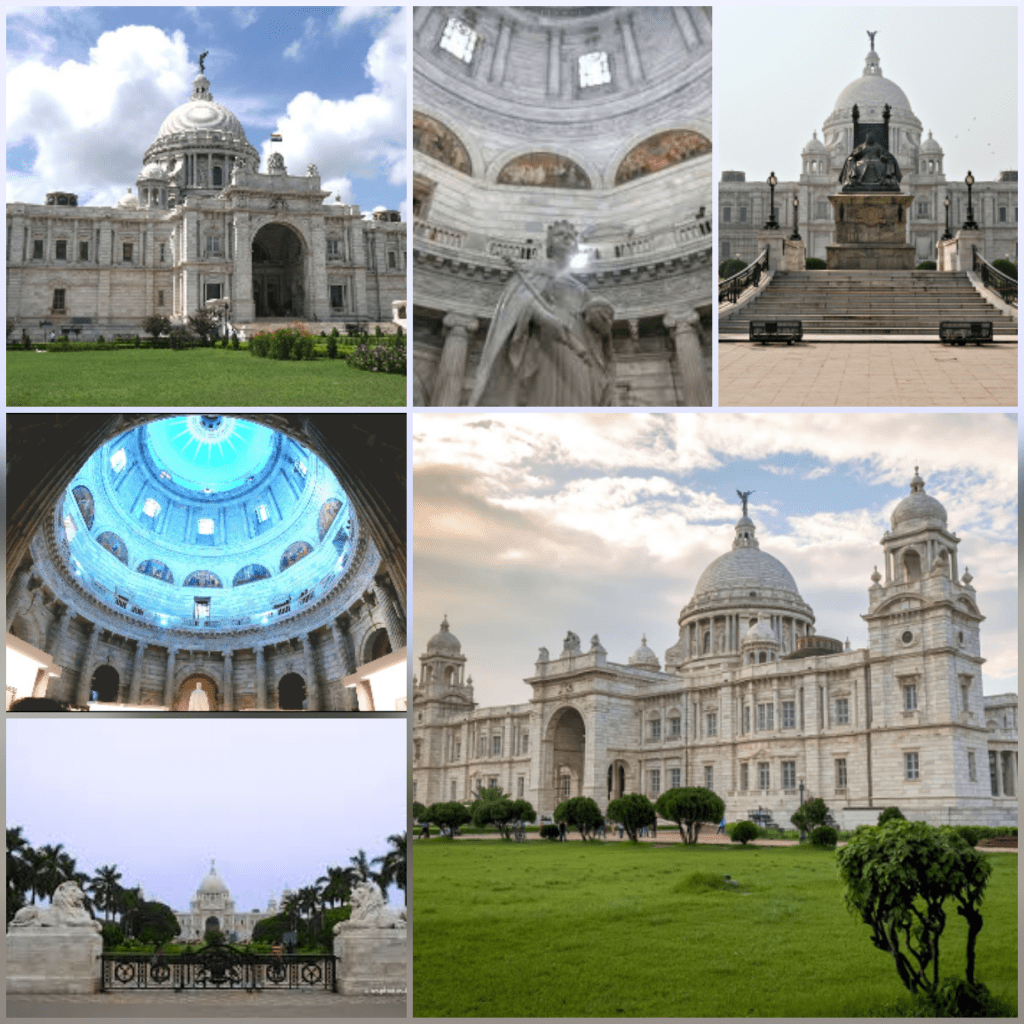
The Victoria Memorial is a large marble building in Kolkata, West Bengal, India, which was built between 1906 and 1921. It is dedicated to the memory of Queen Victoria, then Empress of India, and is now a museum and tourist destination under the auspices of the Ministry of Culture.
The Victoria Memorial is one of the most magnificent monuments of not only the city of Kolkata but of our entire country. Representing the resplendent and majestic British architecture, Victoria Memorial stands today, as a veritable icon of the city of Kolkata. Located on 1 Queen’s way, the Victoria Memorial was envisaged by Lord Curzon, the Viceroy of British India, as a memorial to the deceased Queen Victoria. Hence, according to Curzon this memorial should take form of a great marble hall, which was to be erected on the Calcutta Maidan to serve primarily as a monument to the Queen and secondarily as a national gallery and Valhalla of the Indian Empire.
Lord Curzon, who was then the Viceroy of India, placed the question of setting up a ‘stately’ memorial for Queen Victoria, on her death in January 1901 to the public. The Victoria Memorial is a landmark in the history of Indian architecture and the credit for that justly goes to Lord Curzon who chose persons like Sir William Emerson, President of the British Institute of Architects, to design and plan the building and entrust the construction work to the very famous Messrs. Martin & Co. of Calcutta.
This grandiloquent structure presently houses a museum of British India memorabilia like a large collection of oil paintings and water colours by famous European artists like Charles D’oyly, Johann Zoffany, William Hadges, William Simpson, Tilly Kettle, Thomas Hickey, Bultzar Solvyns, Thomas Hickey, Emily Eden and others. Besides these, the Memorial also houses the largest collection in the world of the paintings by the Daniells.
The Royal Gallery is a storehouse of oil paintings of Queen Victoria receiving the sacrament at her coronation in the Westminster Abbey in June 1838; her marriage with Prince Albert (1840), the christening of the Prince of Wales, the marriage of the Prince of Wales (Edward VII) with Princess Alexandra and others.
The Memorial’s grandeur at a height of 200 feet (184 ft up to the base of the figure of Victory, which is again 16 ft high) is accentuated by the serenity that engulfs you in its corridors. The groups of figures above the north porch represent Motherhood, Prudence and Learning. Surrounding the main dome are figures of Art, Architecture, Justice, Charity etc.
The vastness and splendor of Victoria Memorial can be comprehended from the fact that it has been divided into different divisions like the garden, library and others for maintenance and also houses a host of valuable articles like the dagger of Tipu Sultan, a cannon used in the battle of Plassey, rare books that date back to 1870, valuable manuscripts like the Ain-i-Akbari by Abul Fazal, rare postage stamps and Western paintings to entice the visitors to this awesome monument.
JORASANKO THAKURBARI:
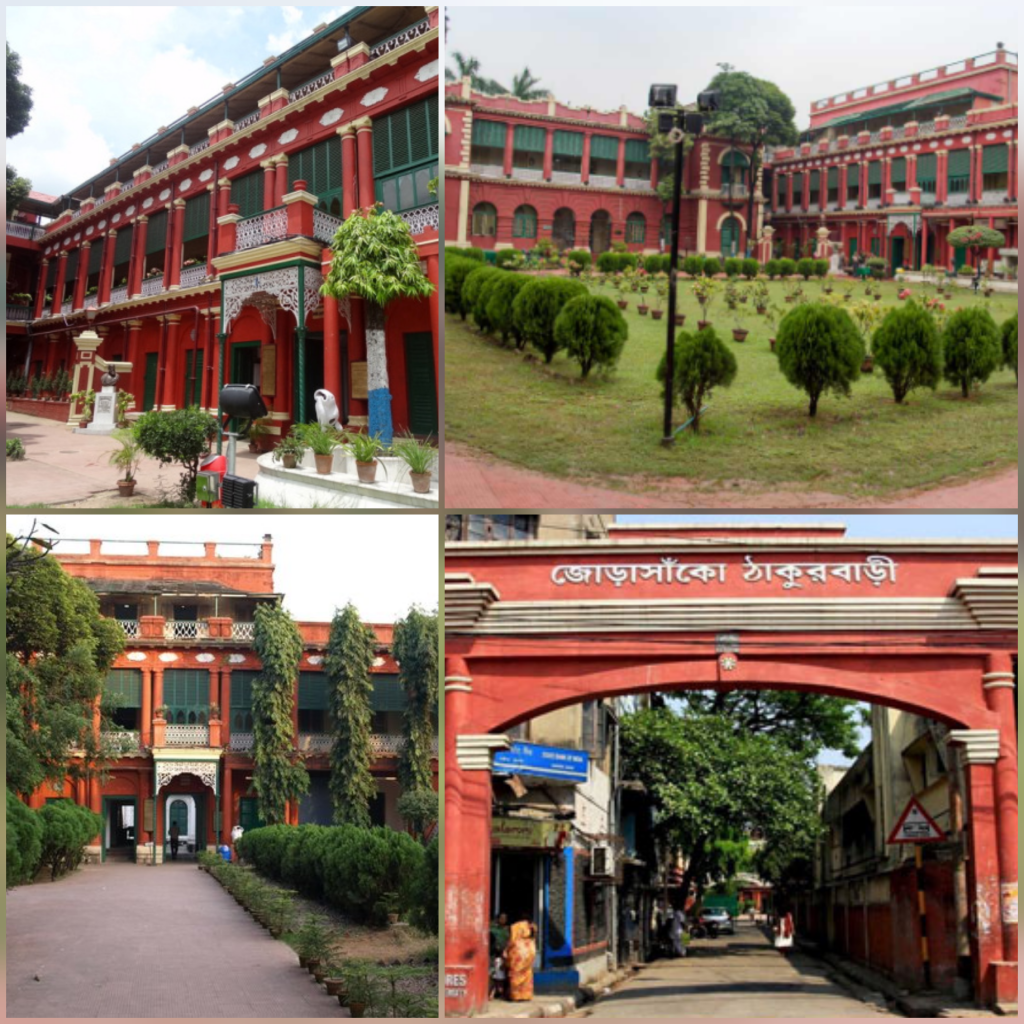
Jorasanko Thakurbari in Jorasanko, North Kolkata, West Bengal, India, is the ancestral home of the Tagore family. It is located on the Rabindra Bharati University campus at 6/4 Dwarakanath Tagore Lane Jorasanko, Kolkata 700007.
It is now a museum dedicated to the life and works of the Nobel Laureate. Built in 1785, the Jorasanko Thakurbari is spread over 35000 square meters. Today the building houses Rabindra Bharati University, inaugurated by Jawaharlal Nehru on Tagore’s birth centenary, 8 May 1962. Within the complex is Maharishi Bhavan, named after the poet’s father, Maharishi Debendranath Tagore, where, as the plaque outside reads, “Rabindranath was born breathed his last here.” Today this house is a museum that has three galleries dedicated to Tagore, members of his family and the Bengal Renaissance. The galleries provide glimpses of intimate family photographs, live size portraits and Tagore’s evolution as a poet philosopher.
The Rabindra Bharati Museum has a total collection of 2071 books, 770 journals, 16 paintings, 3297 photographs, 27 crafts and sculptures, 208 personalia and 53 pieces of furniture. Every year Rabindra Bharti Museum of Kolkata celebrates Poila Baisakh, 25th Baishakh (birthday of Rabindranath Tagore), 22nd Sravana (the date of poets’ demise) and the birth anniversaries of other famous poets.
FORT WILLIAM:

Fort William is a fort in Hastings, Calcutta (Kolkata). It was built during the early years of the Bengal Presidency of British India. It sits on the eastern banks of the Hooghly River, the major distributary of the River Ganges. One of Kolkata’s most enduring Raj-era edifices, it extends over an area of 70.9 hectares.
The fort was named after King William III of England. In front of the Fort is the Maidan, the largest park in the city. An internal guard room became the Black Hole of Calcutta.
The Fort is built of brick and mortar in the shape of an irregular octagon with an area of 5 km. Five of its sides face landward, and three towards the Hooghly River. The design is that of a star fort, suited to defence against cannon firing solid shot, and dates from before the advent of explosive shells. A dry moat 9 m deep and 15 m broad surrounds the fort. The moat can be flooded but is designed as an area in which to use enfilade (or “flanking”) fire against any attackers reaching the walls. There are six gates: Chowringhee, Plassey, Calcutta, Water Gate, St Georges, and the Treasury Gate.
SHAHEED MINAR:

Located at the very heart of Kolkata, the 158-foot high, pristine white Shaheed Minar has remained a landmark monument for over a century and a half. Its characteristic design and size has drawn the attention of many, including Mark Twain who dubbed it the ‘cloud kissing monument.’ However, the structure’s history remains just as interesting as its architecture.
Originally called the ‘Ochterlony Monument’ and was renamed in 1969 in memory of those who lost their lives in the freedom struggle. Constructed in 1828 as a tribute to Major-General Sir David Ochterlony, commander of the British East India Company. The structure sought to celebrate his defence of British occupied territory in the Indian subcontinent against the Marathas and other regional armies. However, in 1969, decades after India gained independence, the monument was rededicated to the memory of the martyrs of the Indian freedom movement. It was then renamed the Shaheed Minar, which translates to ‘the Martyr’s Monument.’
BELUR MATH:

Belur Math is the Headquarters of Ramakrishna Math & Ramakrishna Mission, founded by Swami Vivekananda, the chief disciple of Ramakrishna Paramahansa. It is located on the west bank of Hooghly River, Belur, West Bengal, India and is one of the significant institutions in Kolkata.
It is one of the noteworthy establishments in Kolkata. This temple is the focus of the Ramakrishna Movement. The temple is prominent for its architecture that embraces Hindu, Christian and Islamic styles and stands as an icon of unity of all religions.
Founded by Swami Vivekananda, the chief disciple of Ramakrishna Paramahansa, the temple is at the heart of the Ramakrishna Movement. The temple complex also houses a museum and several other affiliated educational institutions. The evening Aarti takes place 5:30 PM, at which an evening bell is rung to indicate that visitors are not allowed to loiter on the Math grounds and are also not allowed to visit any temple other than Sri Ramakrishna temple. The Aarti songs sung are hymns of praise to Sri Ramakrishna and Sri Sarada Devi. The Aarti here is different from those at other places of worship since one is expected just to sit and meditate. There is no religious offering made. Flowers and sweets are not offered.
The visionary idea of Swami Vivekananda and his brother disciples to carry forward the teachings of their Guru Sri Ramakrishna Paramahansa resulted in the establishment of the Belur Math. The temple is designed to celebrate the diversity of all religions. The foundation stone was laid on 16th May, 1935 by Swami Shivananda. The temple was built with Swami Ji’s idea of incorporating the symbolism of all religions of the world into a unique architectural structure that will speak of Universalism of Faith. The temple was designed by his brother disciple Swami Vijnanananda, a civil engineer in his pre-monastic life. The massive construction was done by Martin Burn & Company.
The architecture of the temple is an amalgamation inspired from the architectural design of different religious faiths. The main gateway of the temple is modelled on the high temple entrances of South India with a hint of Buddhist style. The main temple’s central dome is a replica of European architecture from the Renaissance period while the floor is made in shape of the Holy Cross of Christians. The other three umbrella shaped domes are inspired by the thatched roof styles of Kamarpukur village of Bengal. The exterior walls are adorned in Ajanta styled architecture with different figurines of celestial beings. The windows and balconies remind one of the Rajput and Mughal period. The temple is mainly built of chunar stone and cement. The height of the temple is 112.5 feet (34.3 m) and covers a total area of 32,900 sq ft (3,060 m2). There is a Natmandir or congregation hall attached to the main temple building with Greek styled pillars on both side and embellished with decorations inspired from the Meenakshi Temple in Madurai. There is a beautiful pathway for doing parikrama or circular rounds around the main sanctum sanctorum that is built like the Buddhist chaityas. There is a Golden kalasha placed on the top of the central dome underneath a full-bloomed lotus.
DHASHINESWAR KALI TEMPLE:
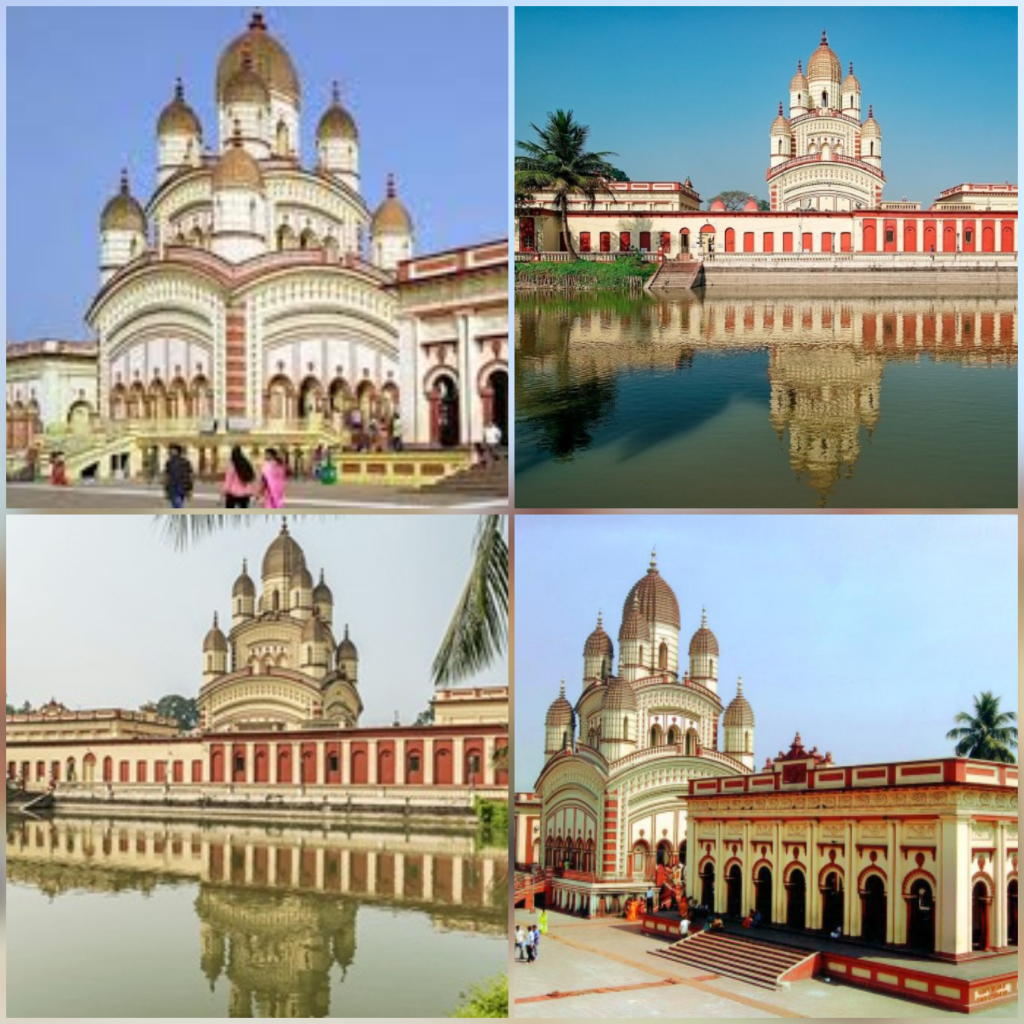
Dakshineswar temple is one of the most revered, sacred temples near Kolkata, dedicated to goddess Kali. Dakshineswar Temple is located at a distance of 20 km north from the central part of Kolkata. It is located alongside the Vivekananda Bridge. The temple admires the eastern bank of River Hooghly. It is also an architectural treasure. The temple was built in conventional Nava-ratna style. It boasts a towering height of more than 100 feet. The 12-spired temple with its massive courtyard is flanked by 12 other small temples, devoted to Lord Shiva. It was founded by Rani Rashmoni on the 31st of May 1855. The holy tithi was of Jagannath Deva Snanyatra. This widely famed temple of Dakshineswar is famous among pilgrims all over the world. It was at this very place that the Rama Krishna Paramhamsa, the highly revered religious thinker attained his spiritual vision and advocated the unity of all religions.
The construction of Dakshineswar temple was initiated in 1847 and it was completed in 1855. The temple along with its abiding areas spans 25 acres of land, which makes Dakshineswar temple one of the biggest temples in Kolkata. The main temple premise is around 46 sq ft. Dakshineswar temple was built in the traditional ‘Nava-ratna’ or nine spires style of Bengal architecture. The temple sports a colossal, elongated structure, resting on a high platform with a flight of stairs. It is a three-story, south-faced temple. The nine spires of the temple are distributed in upper two stories. A narrow covered verandah has been erected, which serves as an audience-chamber and it is attached to the sanctum, which houses the goddess Dakshina Kali. A huge spacious Natmandir (Dancing hall) has been erected in front of the temple.
The Garbha Griha houses the deity of goddess Kali, famously known as Bhavataraini. The idol stands on the chest of Lord Shiva, who rests in a lying posture. The two idols stand beautifully on a thousand-petal lotus, made of silver. This colossal temple of Kali is renowned as one of the rare temples of Indian origin.
Twelve identical shrines of Shiva adorn the premise of Dakshineswar Temple, each housing Shiv Lingas of black stone. At the north east side of the Dakshineswar temple complex, lies the Vishnu Temple or the Radha Kanta’s Temple.
The Panchavati garden, where congregation of five ancient trees is found is an ideal spot for meditation.
Kolkata is famously known for its splendid history and rich art & architecture…. Hence, it can also be called a heaven on earth which may be defined as an Architect’s paradise…
 FREE REIN
Nicely penned. Informative article. Thank you
LikeLike